

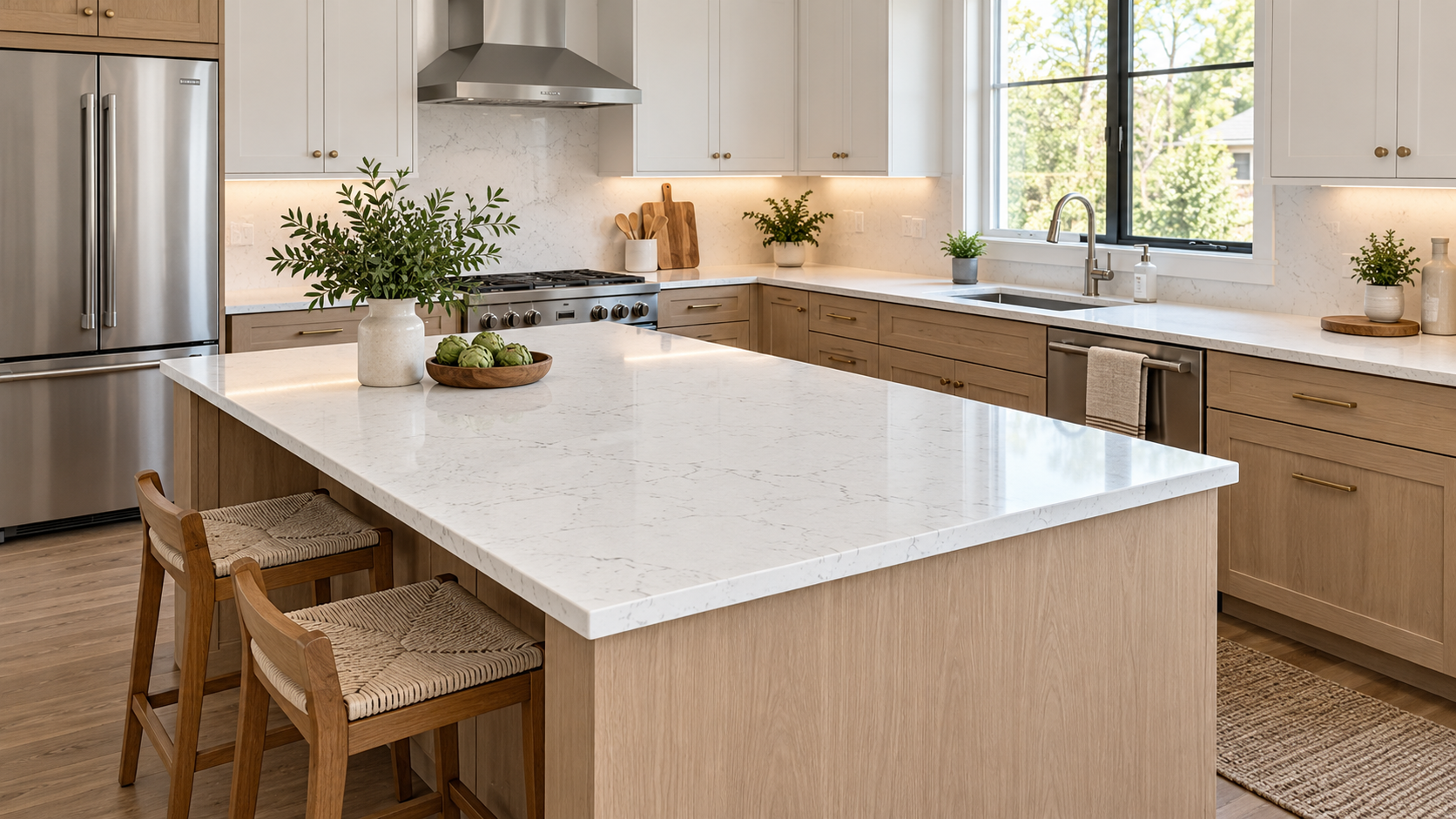

Quartz countertops contain mineral grains held by resin binders, with pigments that create their color and pattern. Ground quartz is a common ingredient, but the exact blend varies by product. The result is a factory-made slab.
That blend explains much of what you get: a nonporous countertop with simple daily care and clear limits around heat. Knowing what goes into it also helps you ask better questions when you choose samples for your kitchen.
The Ingredients in a Quartz Countertop
Each part of a quartz counter has a role: minerals provide much of the structure, while resin holds the grains in a solid slab. Pigments and other added elements help create the finished design.
- Mineral ingredients: Ground quartz is common, with grain sizes that affect the look; some brands also use other minerals or recycled glass. The blend differs between brands and product lines.
- Resin binders: These bind the mineral grains so the finished surface works as a whole. A quartz crystal’s hardness alone does not tell you how the entire counter will perform.
- Pigments and design elements: These create color and pattern, from fine speckles to broad veins. Some designs have a quieter background, giving you options to compare with your cabinets.
Quartzite belongs to a different category because it is natural stone cut from quarried slabs. Quartz counters an engineered blend of mineral content, resin, and pigmented design elements combined to create a slab, oftentimes replicating designs from marble or another natural stone.
How the Blend Becomes a Finished Slab

Slab makers turn the blend into a dense surface in a factory, with methods that vary by product. The basic steps are:
- Blend the ingredients: Mineral grains mix with binders and pigments, with placement helping to form the pattern.
- Compact the mixture: Vacuum, vibration, and pressure compress the blend and reduce trapped air.
- Cure the slab: The binder cures, or hardens, to bind the grains into a solid slab.
- Finish the surface: The slab is sized and finished to give it the right thickness and look.
The result is a nonporous surface that does not require resealing, which keeps daily care simple. Quartz also offers stain resistance for a busy kitchen.
Wipe spills promptly and use mild soap and water or Lakeside’s Pristine Clean (™). Our everyday quartz cleaning guide covers the basic approach. Nonporous does not mean self-cleaning, and a stain-resistant surface still needs regular care.
Set cookware from the oven or cooktop on a trivet.
Heat protection matters because all parts of the slab respond to heat, including the resin. Check the care guide for heat pads beneath small appliances as well.
Plan engineered quartz for indoor use. UV light can change the color of resin-based surfaces, so we do not recommend it for outdoor countertops. For those projects, ask about a suitable natural stone or porcelain slab.
Use the care guide for the finished counter when choosing cleaners, too. A cleaner that suits one mineral may not suit the whole blend.
What to Check When Choosing Quartz for Your Kitchen

Start with the brand and exact product name to find the right care instructions and warranty terms, even when several samples look alike.
Compare the finish as well as the design, since textured and polished surfaces can reflect light differently and may have different cleaning guidance. Check how the sample looks against your cabinets in daylight and under the lights you use at night.
For larger veined designs, ask to see more of the pattern. A small sample cannot show where a broad vein will cross an island or meet a seam.
Fabrication fits the slab to your room through seam planning and cutouts, with edge shaping and final preparation before installation.
Lakeside’s in-house team handles laser templating, custom fabrication, and professional installation, working with finished slabs supplied by the slab maker.
Before moving forward, confirm:
- The product and finish listed on your quote.
- The care instructions that apply to that selection.
- The proposed pattern layout and seam locations.
- The work included in the installed price.
You can explore our quartz countertops to begin comparing designs, using what you know about the product to narrow your choices.
Compare Quartz Samples With Clearer Expectations
Choosing quartz is easier when you can connect its look with the way you use your kitchen. You know why it needs no routine sealing, why trivets still matter, and which product details to review before fabrication.
Lakeside Surfaces helps homeowners across Michigan’s Lower Peninsula compare surfaces in the context of their homes. During a consultation, we can discuss your preferred look alongside care needs and the details of your countertop project.
Frequently Asked Questions
Are quartz countertops natural or manufactured?
Quartz countertops are factory-made surfaces that combine natural minerals with resin binders and pigments. Quartz is a natural mineral, but slab makers do not cut a whole quartz counter from one quartz deposit. Natural quartzite is a separate stone category, with its own makeup and care needs.
Are all quartz countertops 93% quartz?
No. Blends vary by brand and product, and some newer mineral surfaces use different blends with reduced or 0 crystalline silica. A percentage also needs context: total mineral content is not the same as quartz content or crystalline silica content. Check the spec sheet for the exact product, since one familiar recipe cannot serve as a guide to every quartz slab.
Does the resin mean quartz needs sealing?
No. Engineered quartz is normally nonporous, so daily care does not include routine sealing. The resin holds the minerals in place as part of the finished slab. Follow the product’s care guide instead of adding a sealer meant for porous stone. Daily cleaning still matters, along with prompt spill cleanup and a trivet beneath hot cookware.
Does Lakeside make the quartz slabs?
Slab makers produce engineered slabs from their own blends. Lakeside’s in-house team handles the work that fits those slabs to your project, including laser templating, custom fabrication, and professional installation. The slab maker sets the blend and care guidance, while we plan and complete the counter work for your space.