

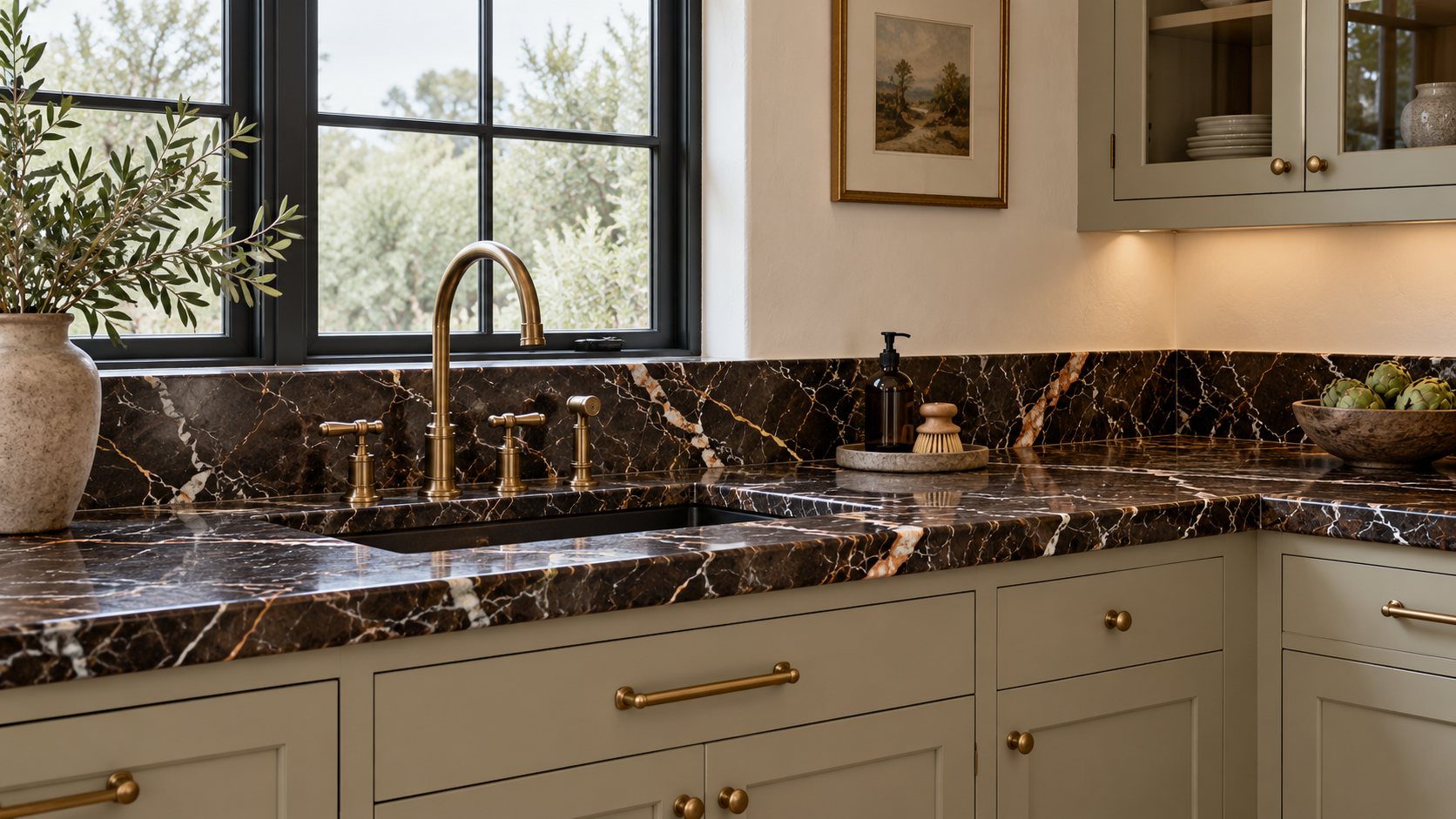

Quartzite vs. Marble Countertops: Durability, Care, and Appearance
Quartzite and marble both bring natural depth and individual pattern to a kitchen. Quartzite generally offers greater resistance to scratches and acid etching, while marble offers its own character with more change in the finish.
When comparing quartzite vs. marble, look beyond similar colors. The useful differences show up during cooking and cleanup. Comparing the same kitchen tasks, then reviewing the actual slab, helps you see which stone suits the way you cook.
How Quartzite and Marble Look in a Kitchen

Quartzite and marble are both natural stones, but they form from different types of rock. Quartzite develops from quartz-rich sandstone under heat and pressure. Marble forms from limestone or related carbonate rock, which gives it different traits.
Quartzite differs from engineered quartz: a quartzite slab comes from quarried stone, while a quartz slab uses a factory-made blend of minerals and binders.
You cannot always tell those stones apart by sight.
Some light quartzites can have flowing movement that recalls marble, while other selections show a more grainy or crystalline texture. Marble can range from fine gray veining to broad movement across a warmer background.
Look at full slabs to see the depth and variance that give each stone its own pattern, rather than expecting one familiar look.
Consider where the pattern will sit: a long vein may define an island, while a busy section near a sink can create a different effect. Cabinet color and room lighting also change how warm or cool the surface appears.
Our natural stone guide explains the broader material choices. For this comparison, the more useful question is how each stone behaves once the kitchen is in use.
How They Handle the Same Everyday Kitchen Use
Compare specific tasks rather than asking which stone is more durable in every possible way. How a stone handles scratches is separate from how it reacts to acid or takes in spills.
- Preparing food with citrus: Marble contains minerals that react with acids such as lemon juice. That reaction can leave a dull etch mark, even on a sealed countertop. True quartzite resists etching from common kitchen acids. Use a board for prep and wipe spills promptly on either surface.
- Cleaning up oil: Both stones need care matched to the actual slab. A stone’s resistance to scratching does not tell you how easily liquids soak into it. A suitable sealer can slow absorption where needed, but it cannot make a porous stone stain-proof.
- Moving objects across the counter: Quartzite generally resists scratches better than marble. Marble’s softer surface can show wear more easily. Avoid dragging rough-bottomed items across either countertop, and keep cutting on a board.
- Setting down cookware: Both stones have natural heat resistance. Use a trivet beneath hot pots to protect the finished surface and reduce the stress of sudden temperature changes.
For cleaning, use a pH-neutral stone cleaner or the care product advised for your stone. Avoid assuming that a strong household cleaner is suitable just because the stone is hard.
You can review our countertop care guidance when comparing routines. Ask about the care your stone needs before it reaches your home.
What to Confirm Before You Choose a Slab

Confirm what the stone is, especially when a marble-like slab is sold under a quartzite name. A trade name does not always tell you what a stone contains. If the expected performance is unclear, ask your stone supplier to check it before you commit.
The Natural Stone Institute’s quartzite guide explains why labeling matters. Have a stone specialist confirm the type; do not apply acid or try scratch tests on an installed countertop or a slab offered for sale.
Then review how the stone will become your countertop:
- Finish: Compare the sheen you prefer and ask how wear may appear on it.
- Layout: Review vein direction across the main work areas and any necessary seams.
- Support: Confirm the cabinet preparation and support your layout requires.
- Care: Ask which treatment the stone needs and how to tell when it needs sealing again.
Compare quotes using the same installed scope, since slab rarity affects price along with fabrication work and site access. Either stone can cost more.
Choose the slab that gives you the look you want with care you can keep up. That keeps the decision focused on how you will use the room.
Compare Both Stones With Your Kitchen in Mind
Choosing between quartzite and marble gets easier when you can relate the material to your home. We help you discuss appearance alongside everyday care, then consider the layout details that affect the finished countertop.
Lakeside Surfaces serves Michigan’s Lower Peninsula with an in-house team for laser templating, custom fabrication, and professional installation.
You can explore our natural stone countertops before discussing options for your project.
Frequently Asked Questions
Is quartzite harder than marble?
Yes, true quartzite is generally harder and more resistant to scratching than marble. That helps explain its appeal in busy kitchens, but hardness does not describe every type of wear. It does not tell you how fast liquids can soak in or remove the need for proper support. Check the actual stone and its care needs, as well as its look, before you choose.
Can quartzite etch like marble?
True quartzite resists etching from common kitchen acids such as lemon juice and vinegar. If a stone sold as quartzite shows a dull reaction, ask a professional to assess the material and any surface treatment. The trade name may not tell the full story. Avoid testing the countertop yourself or assuming another coat of sealer will resolve the issue.
Do marble and quartzite both need sealing?
Many selections benefit from sealing, but the need and timing vary with the stone and the way it has been finished or treated. Quartzite’s hardness does not automatically make it nonporous, and marble does not come with one universal resealing calendar. Ask for instructions specific to your selection. Sealing reduces absorption; it does not change marble’s sensitivity to acids or make either stone scratch-proof.
Is quartzite more expensive than marble?
Either stone can cost more, depending on the slab and project. An uncommon marble may cost more than a readily available quartzite, while a quartzite layout with demanding fabrication can raise the installed price. Before comparing totals, ask what each quote covers so you can check that the work matches, including edge details and cutouts.